Projectors
Paillard’s single and multi-format projectors for the amateur and home-movie market. 27 models, each with its original specifications.
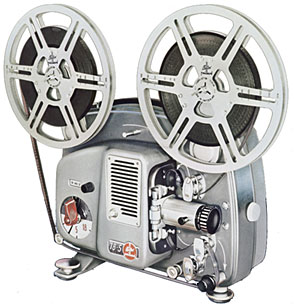
18-5
19618mm
Projected 8mm film at fixed speeds of 18 and 5 frames per second forward, and 18 fps in reverse.
10 specifications3 photographs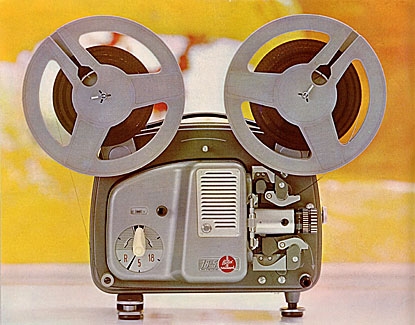
18-5 Auto
19638mm
Specifications and history of the Paillard Bolex 18-5 Automatic loading 8mm projector.
10 specifications3 photographs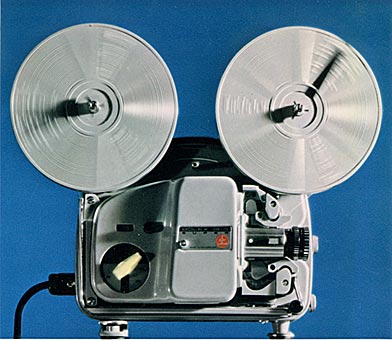
18-5 Super
1965Super 8
Specifications of the Paillard Bolex 18-5 Super-8 film projector.
10 specifications3 photographs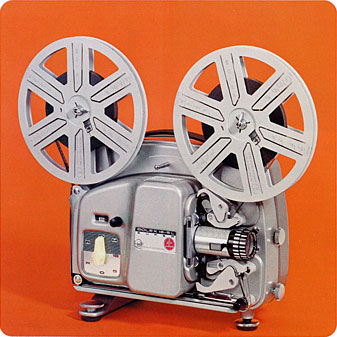
18-5L
1967Super 8
Specifications and history of the Paillard Bolex 18-5L Super 8 projector.
10 specifications4 photographs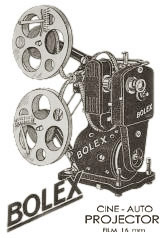
Auto Cine
1928projector
Specifications and history Jacques Bogopolsky's Auto Cine projector for 16mm and 9.5mm film
10 specifications2 photographs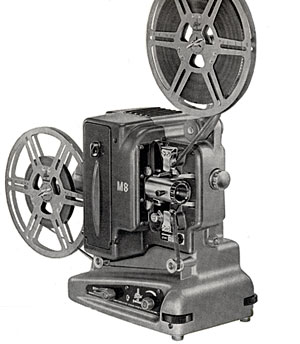
M-8
19508mm
Designed to run off a mains power supply of 110–125 Volts.
10 specifications2 photographsM-8R
19508mm
Specifications of the Paillard Bolex M-8R 8mm projector.
10 specifications2 photographs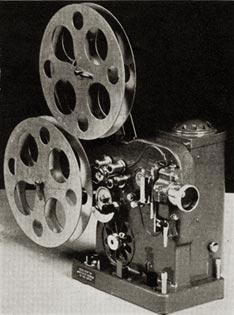
Model C
193016mm
Specifications of the Bolex Model C projector for 16mm film.
8 specifications1 photographs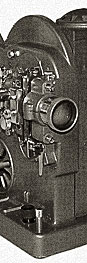
Model D
1931projector
Specifications of Bolex Model D projector for 9.5mm and 16mm film
8 specifications2 photographs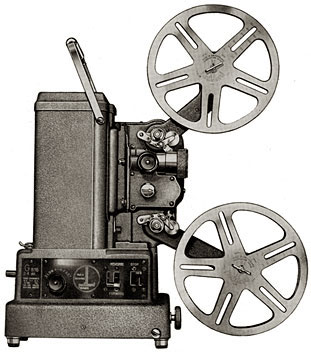
Model G
19368mm / 9.5mm / 16mm
Introduced in 1936 in "monofilm" and "multifilm" models; the multifilm included a tool-free parts kit of reel spindles, sprockets, gate and guide-rollers to adapt the projector to various film gauges.
10 specifications3 photographsModel P
19329.5mm
Specifications of the Bolex Model P projector for 9.5mm film
8 specifications1 photographs
Multimatic
1969projector
Specifications of the Paillard Bolex cartridge loading Multimatic movie projector for Super 8 film
10 specifications3 photographs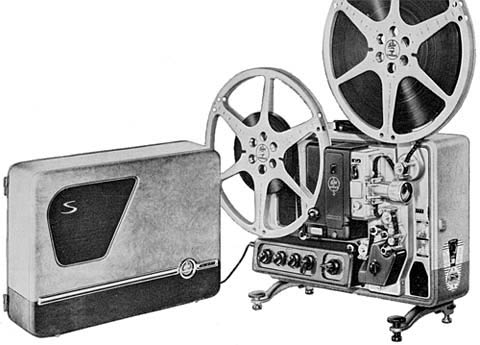
S-211
196016mm
Specifications of the Paillard Bolex S-211 movie projector for optical sound 16mm film
12 specifications2 photographsS-221
196016mm
Plays back silent or sound film with optical or magnetic tracks, and records sound onto 16mm magnetic-striped film.
12 specifications3 photographs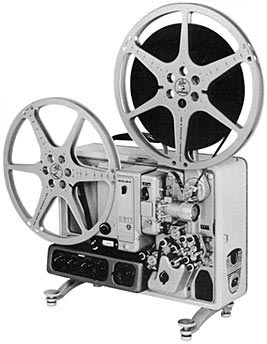
S-311
196816mm
Specifications of the Paillard Bolex S-311 movie projector for optical sound 16mm film
12 specifications2 photographs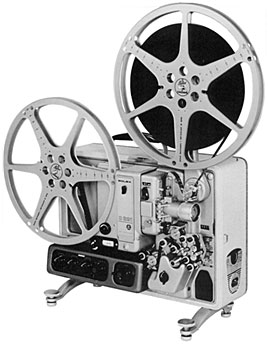
S-321
196816mm
Specifications of the Paillard Bolex S-321 movie projector for magnetic and optical sound 16mm film
12 specifications3 photographs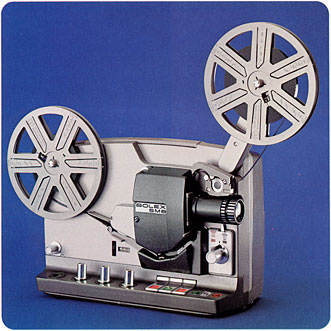
SM 8
1967Super 8
Magnetic sound projection and recording, with a built-in 2W / 15 Ohm speaker.
12 specifications3 photographs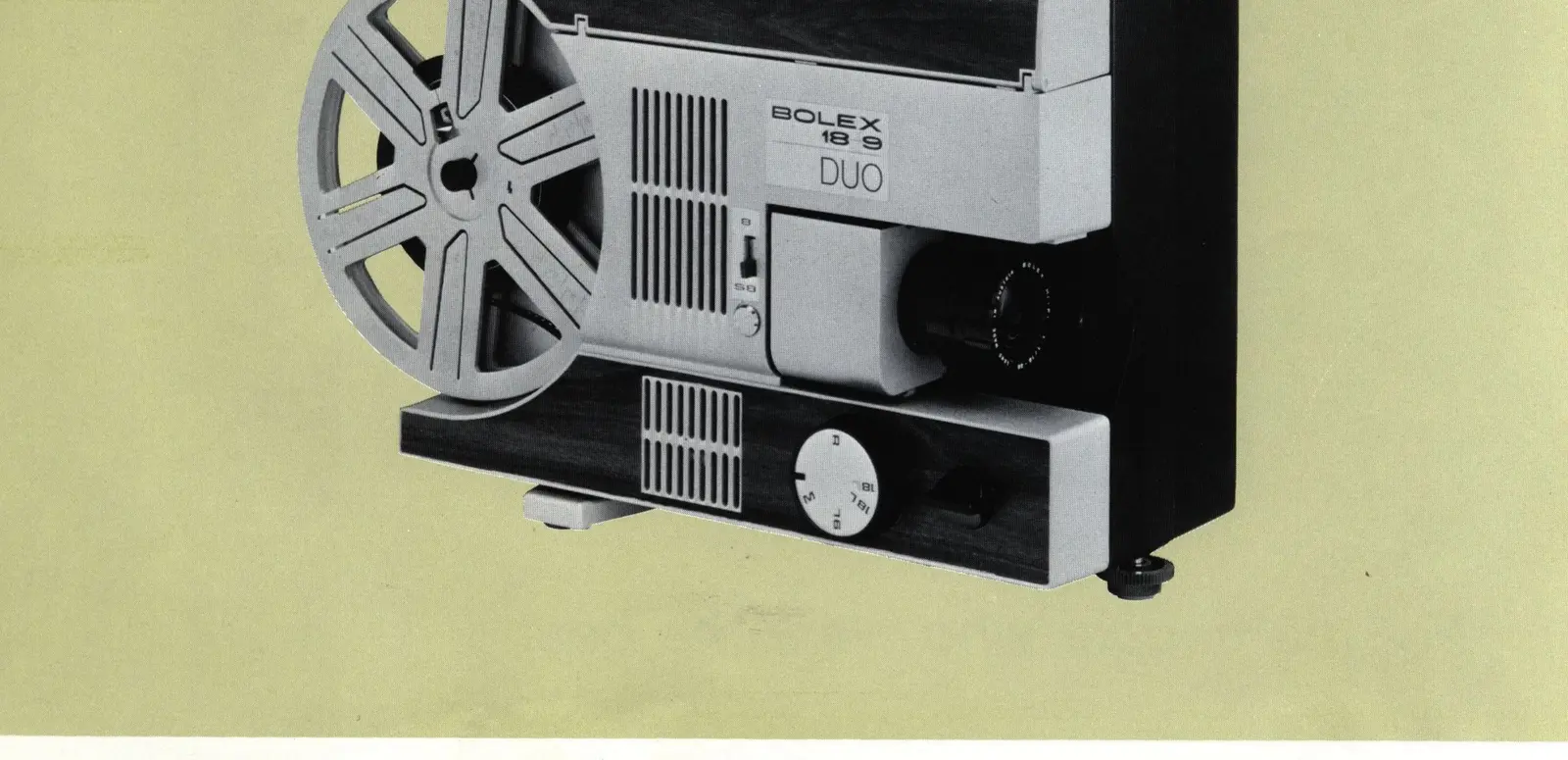
18-9 DUO
Super 8
The projector that takes everything. Reels from 50 to 400 feet, Kodak cartridges from 50 to 400 feet, and regular 8 as well as Super 8, which is what the DUO means. 18 frames a second or 9 for slow motion. A f/1.3 15-30mm Paillard Bolex Hi-Fi zoom and a 100W mirror halogen lamp. It stops itself at the end of the film, the film can stay attached to the reel so nothing needs fixing on before a rewind, and it rewinds fast through the gate or reel to reel, whether the film ran all the way through or not. $189.50 in February 1972.
1 photographs501
16mm
The plainest of the three, and sold as such: a 16mm projector for silent films and for sound films with an optical track only, meant for showing hired prints rather than making anything. Bolex's own pitch is ease of use and an attractive price, and its reasoning is that almost every hired film carries an optical track, the exceptions being originals and films that exist in only a few copies. Universal model for 118 to 240V at 50 or 60Hz, with the Kiptaron 50mm f/1.3 or the Bolex Hi-Fi 35-65mm f/1.6 zoom.
510
16mm
A 16mm projector for silent films and for sound films with either an optical or a magnetic track, which is the 521's range of playback without its recording. Bolex sold it on its speeds: several of them, with freezing on a frame and single-frame projection, which the brochure recommends to schools because movement can be taken apart and looked at phase by phase. Universal model for 118 to 240V at 50 or 60Hz, with the Kiptaron 50mm f/1.3 or the Bolex Hi-Fi 35-65mm f/1.6 zoom.
521
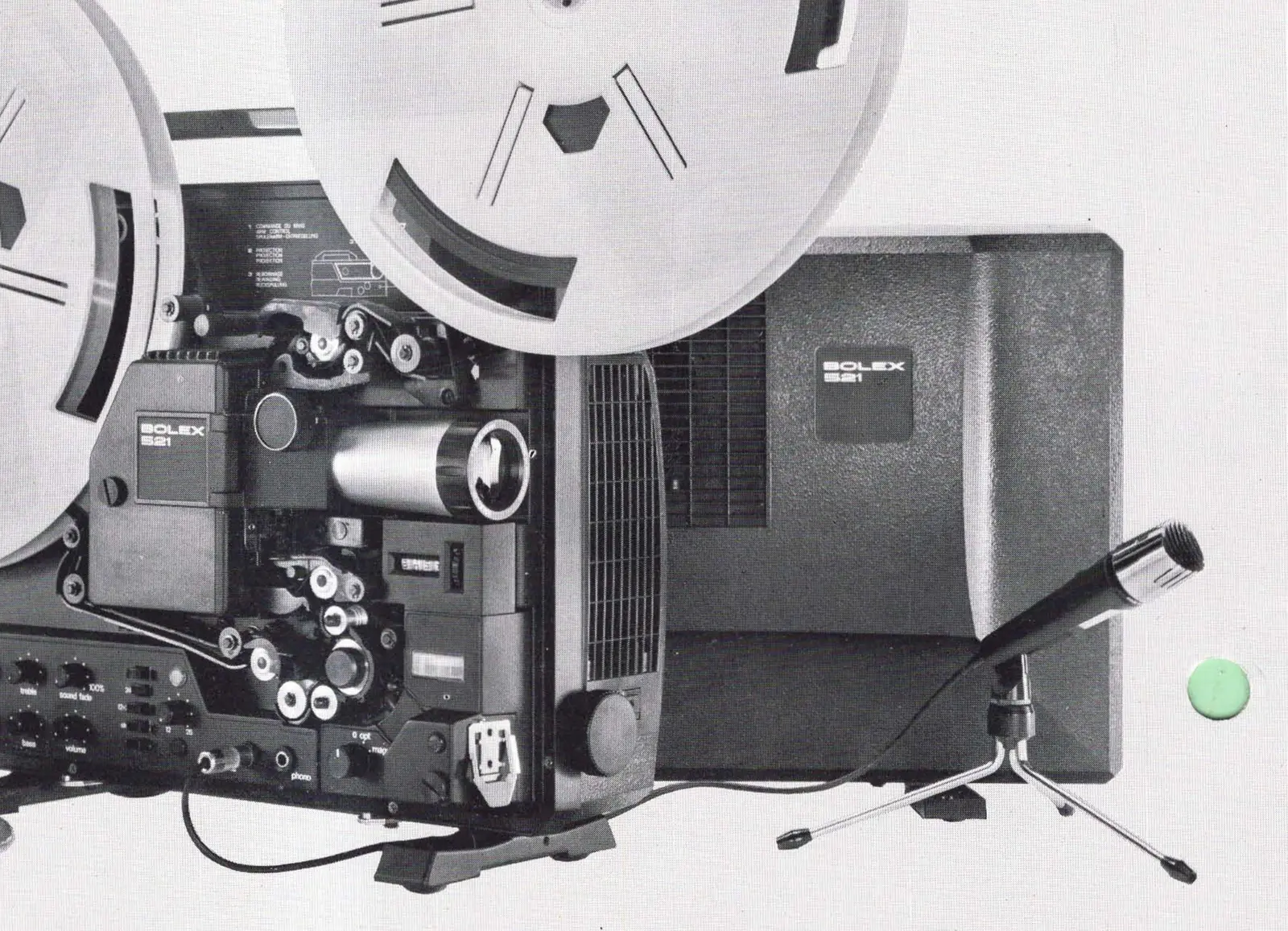
16mm
A 16mm sound projector that records as well as plays, and the most serious projector Bolex made. It takes any 16mm film, single or double perforated, silent or with an optical or a magnetic track, and will record on the magnetic stripe with direct mixing, superimposition and sound fading. Spools to 2000ft, automatic threading, a low-voltage motor under electronic regulation, and speeds of 18 and 24 with anything from 12 to 26 on a potentiometer, plus freezing on a frame and single-frame projection. The amplifier is fully transistorised in three plug-in units, 25W at 2 per cent distortion into 8 ohms, with a 3W monitor speaker in the body and a 10W one in the lid. Recording level is set on separate microphone and phono potentiometers and watched on a lit VU meter, with threshold compression, a variable-erasure control for dissolves, and a double lock so nothing is erased by accident. Magnetic response 100 to 12,000 cycles at 24 f.p.s., optical 50 to 7,000, wow under 0.3 per cent. A 24V 250W halogen lamp with a dichroic mirror and a choice of three lenses, 50mm f/1.3, 70mm f/1.6 or the 35-65mm f/1.6 zoom. Die-cast aluminium with a plastic lid that forms its case, 480 by 380 by 240mm, about 40lb. $3,727.00 in January 1978.
1 photographsSM 80 Programmatic
1977Super 8
The top of Bolex's Super 8 sound range at the end of the 1970s, and a different machine from the SP 80 despite the name. It records on both sound tracks rather than one, takes 800ft reels rather than 600, and carries a Bolex Hi-Fi f/1.2 12.5 to 25mm zoom and a 100W halogen lamp with a dichroic reflector. A track selector gives either track or both, with fading, sound-on-sound, an automatic level limiter, manual override and an LED meter; a sync socket also drives an outside tape recorder, so it works single or double system. 18 and 24 frames a second, with a counter. Built in Austria by Eumig. Bolex (U.S.A.) listed it at $780.00 in April 1979, the dearest projector on the page.
Sound 714
1978Super 8
A Super 8 sound projector that plays and records on both tracks, in mono or duo. The lens is a Bolex Hi-Fi f/1.3, 15 to 30mm. A 100W 12V EFP lamp, 600ft reels, magnetic sound recorded on both tracks with fading and sound-on-sound, levels set automatically or by hand, mixing, microphone and gramophone inputs, and a public-address output. 10W sinusoidal and 15W music power, into a 10W speaker. About 6kg, 221 by 206 by 335mm. Built in Austria by Eumig. It is the 715 without that projector's adjustable lens height, and nothing else separates them. $472.00 in April 1979.
Sound 715
1978Super 8
The Sound 714 with an adjustable lens height, which is the only working difference between them, and a slightly wider lens: a Bolex Hi-Fi Nivar f/1.3, 14 to 30mm against the 714's 15 to 30mm. Otherwise the same machine. Plays and records magnetically on both tracks, mono or duo. A 100W 12V EFP lamp, 600ft reels, magnetic sound recorded on both tracks with fading and sound-on-sound, levels set automatically or by hand, mixing, microphone and gramophone inputs, and a public-address output. 10W sinusoidal and 15W music power, into a 10W speaker. About 6kg, 221 by 206 by 335mm. Built in Austria by Eumig. $518.00 in April 1979, forty-six dollars more than the 714.
Sound 815
1978Super 8
The odd one of the three, and Super8Data calls it a television type projector. Its lens is fixed rather than a zoom, a Bolex f/1.3 of 13.6mm, which is the short throw that description implies. It plays back on the main track only, in mono, but still records on both with fading and sound-on-sound. A 100W 12V EFP lamp, 600ft reels, 10W sinusoidal and 15W music power into a 10W speaker, levels automatic or manual, mixing, microphone and gramophone inputs and a public-address output. Built in Austria by Eumig. $590.00 in April 1979, the dearest of the three.
SP 8
1972Super 8
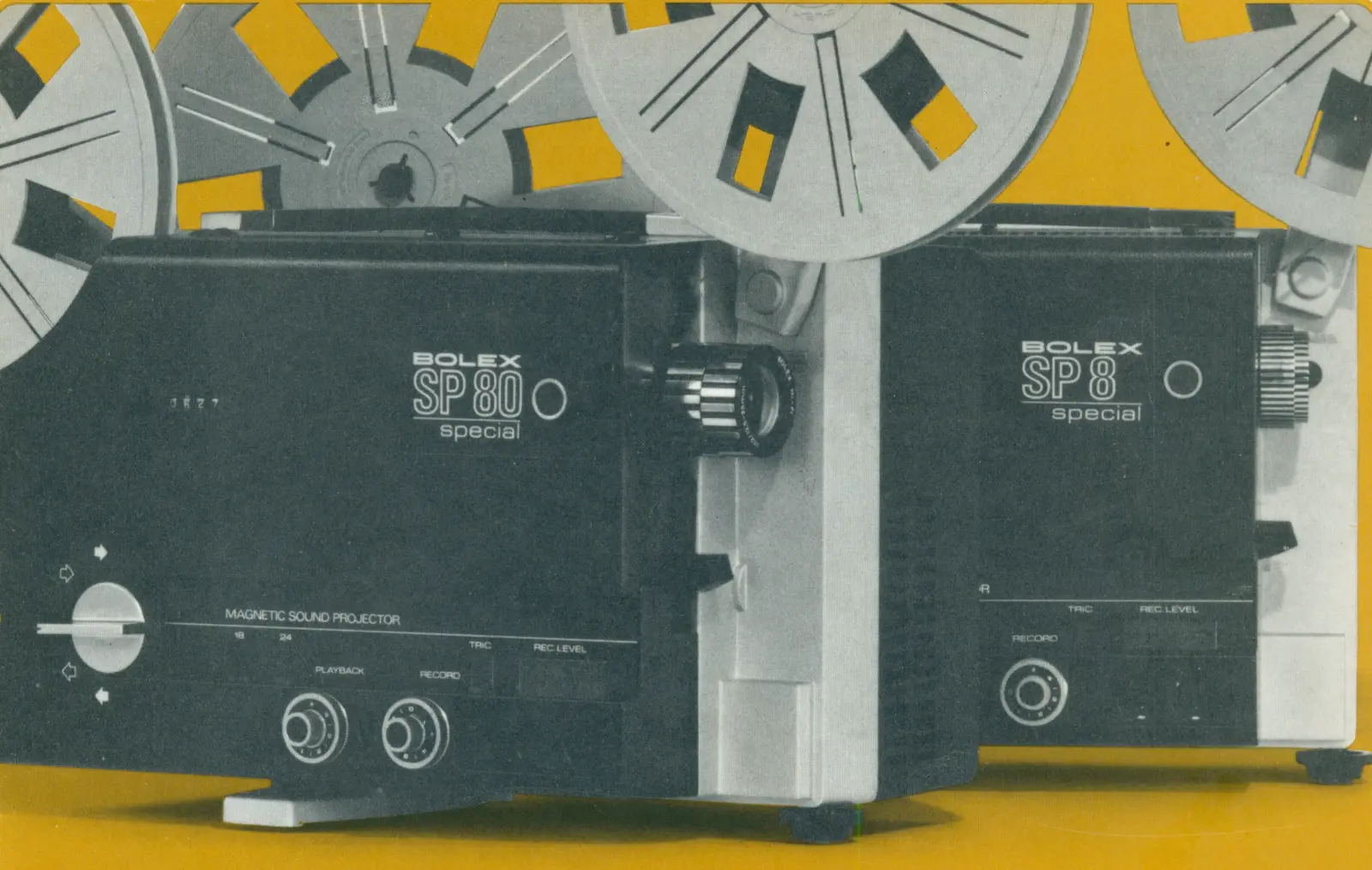
A Super 8 magnetic sound projector that records as well as plays back, sold from 1972 with a f/1.3 15 to 30mm zoom, a 100W 12V lamp, automatic threading, forward and reverse running, 18 and 24 frames a second and 600ft reels. Sound goes on the main track, with fading and sound-on-sound, and the level can be set by hand or left to an automatic limiter. Built in Austria by Eumig, who had bought Bolex in 1969, on the same chassis as Eumig's own Mark S. Paillard's February 1972 dealer list prices it at $299.50, between the 18-5L Super at $199.50 and the SM8 Sound at $449.50. A SP 8 Special was also sold, and the later SP 80 is built on it: Bolex's booklet covering both Specials calls them practically identical, the SP 8 special's amplifier being the smaller at 6W sinusoidal against 10W.
1 photographs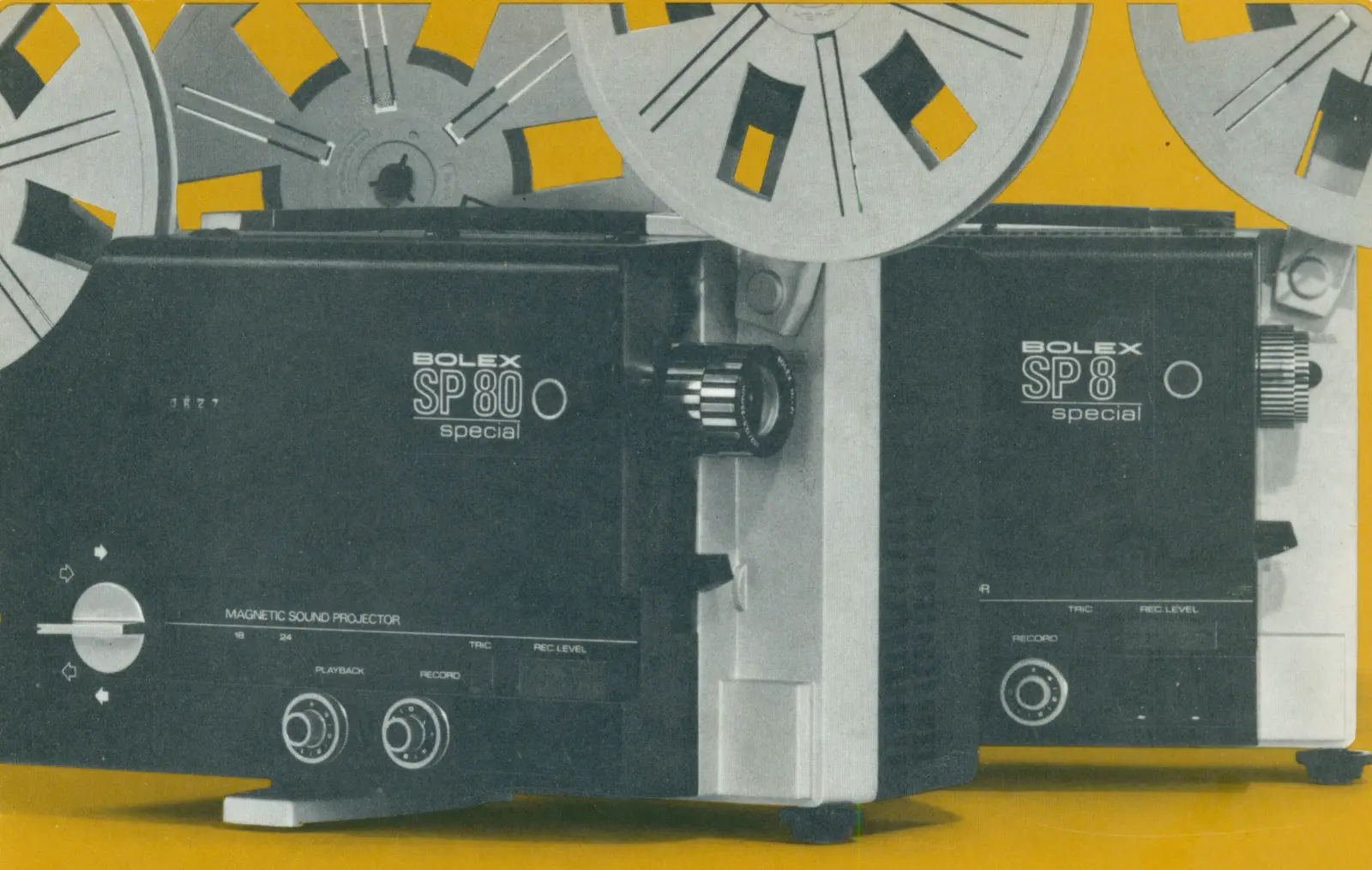
SP 80
1973Super 8
A Super 8 and Single-8 projector with magnetic sound it can both record and play back, with automatic threading, forward and reverse running, 18 and 24 frames a second and 600ft reels. From after Eumig acquired Bolex in 1969, and built on Eumig's own mechanism rather than a Sainte-Croix design. A variant was sold as the SP 80 Special, and Bolex's own booklet for it says the SP 80 special and SP 8 special are practically identical, differing mainly in amplifier power: 10W sinusoidal against the SP 8 special's 6W.
1 photographs