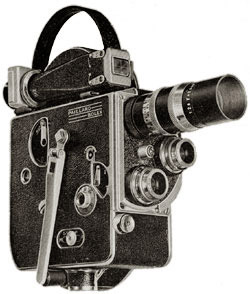
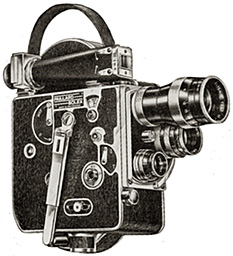
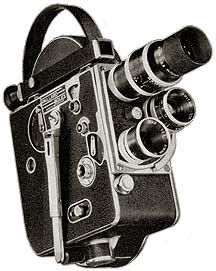
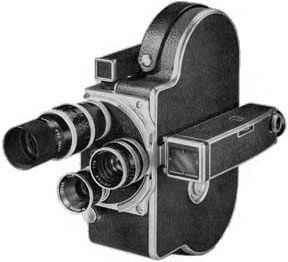
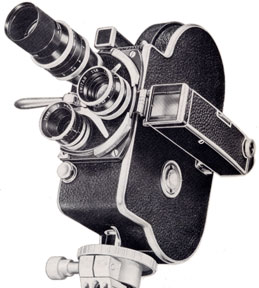
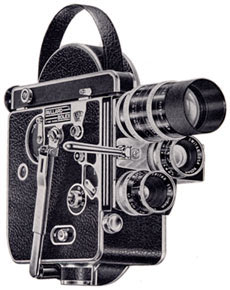
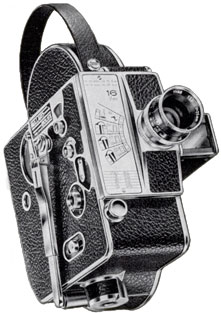
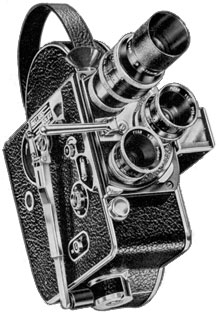
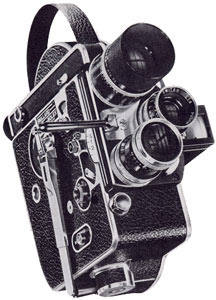
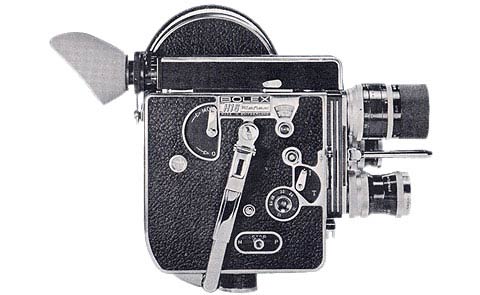
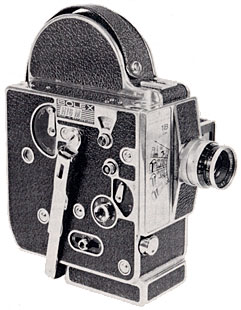
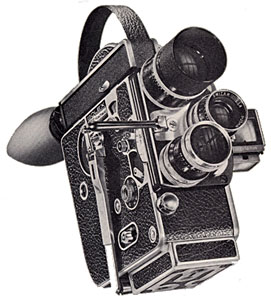
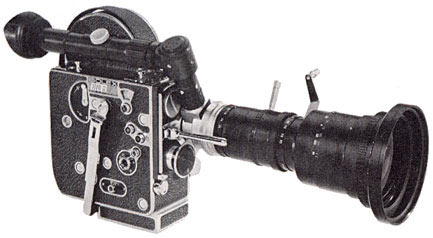
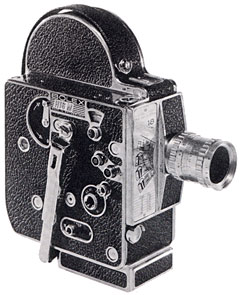
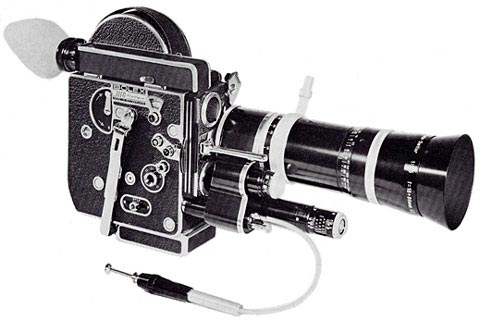
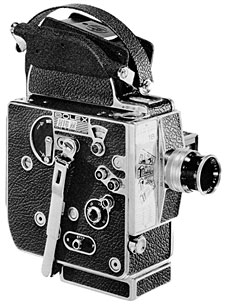
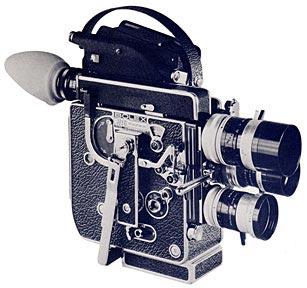
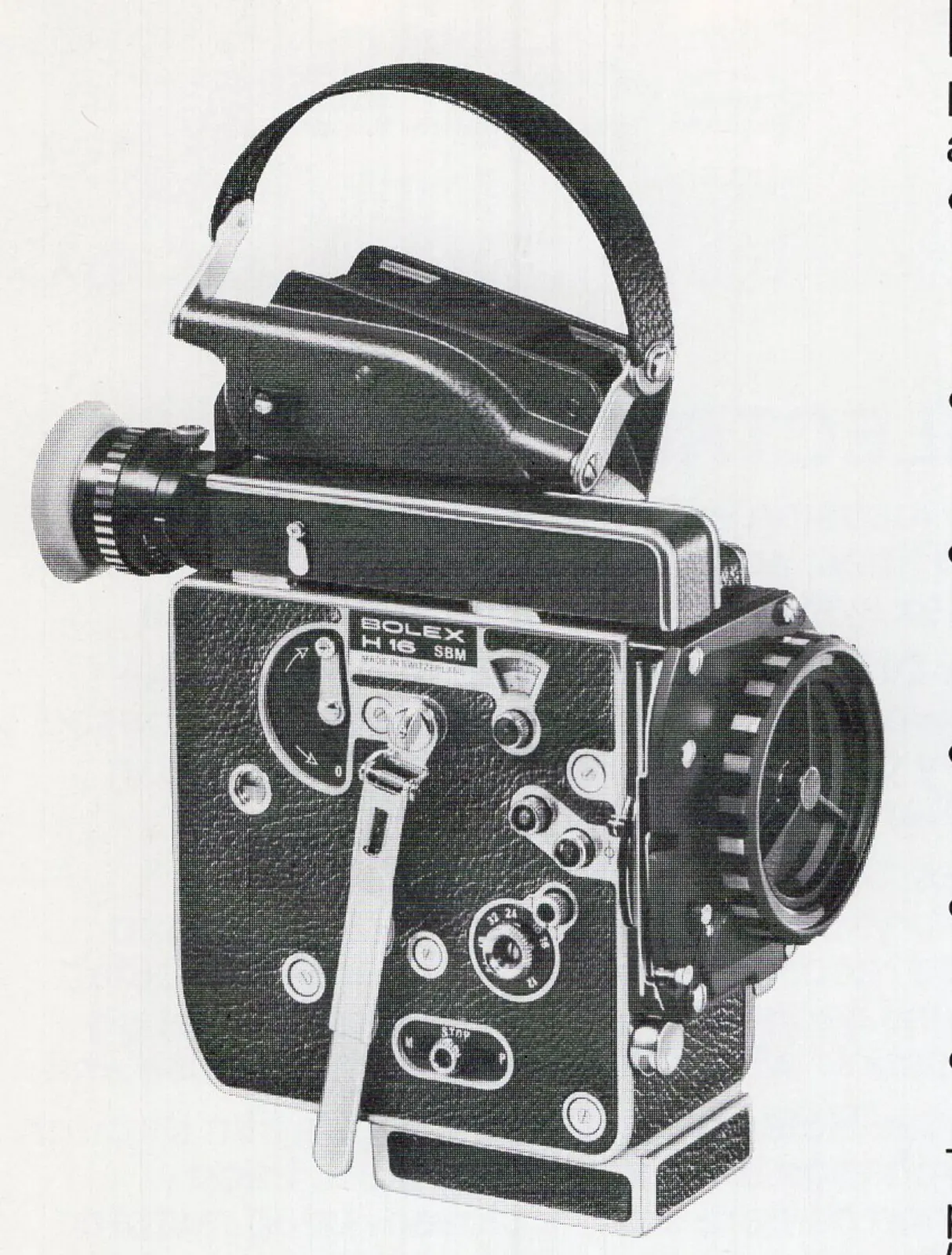
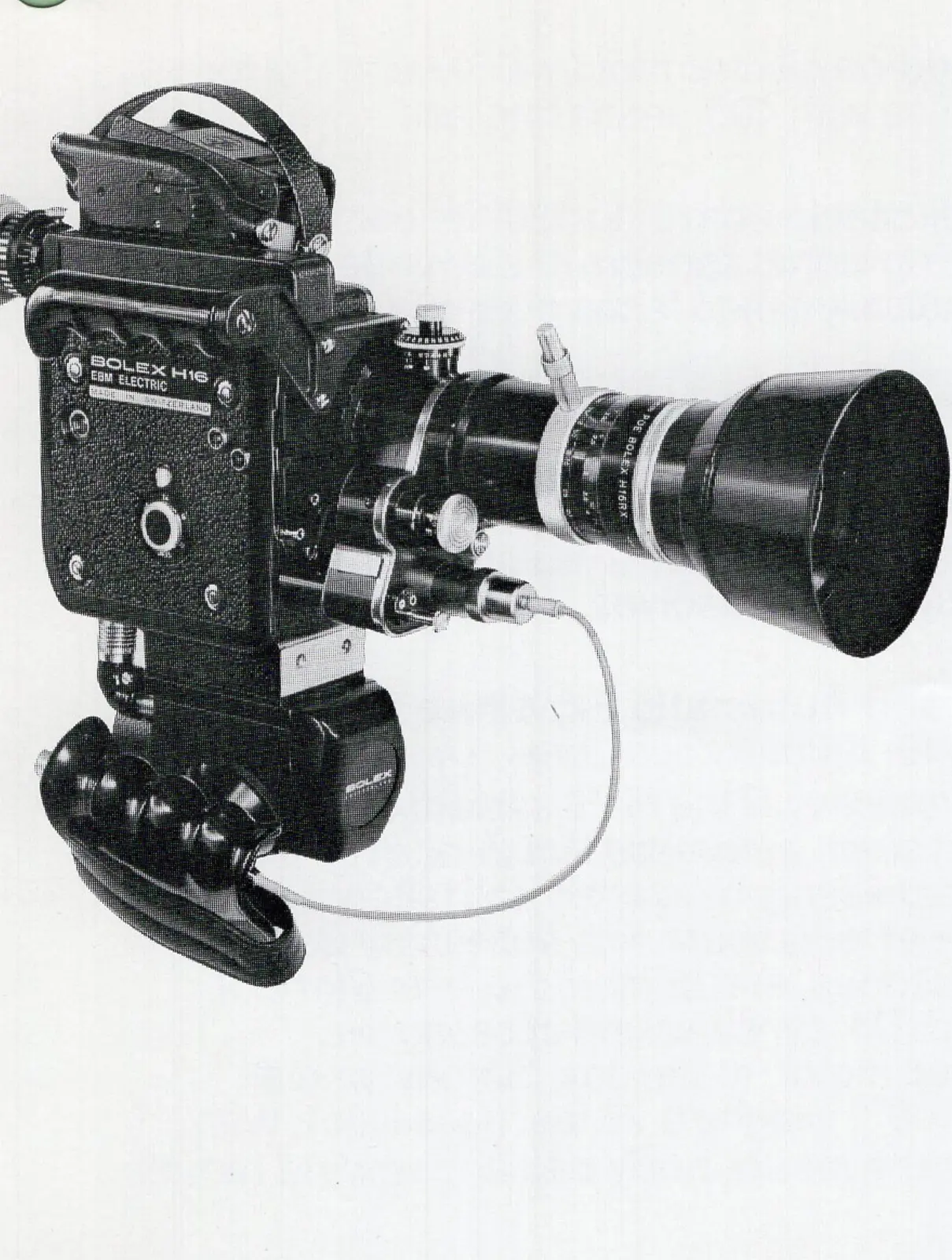
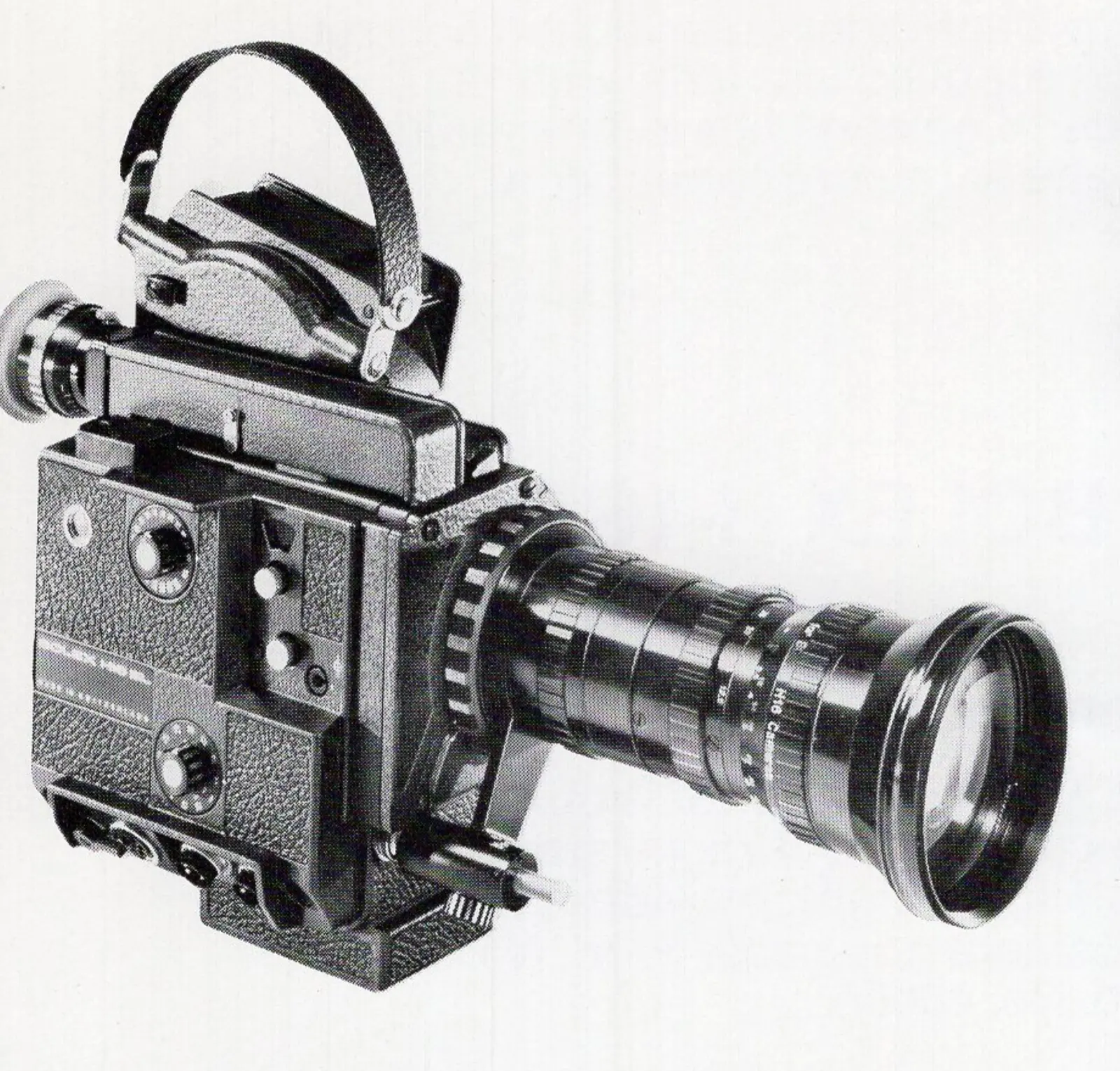
H-16 REX
- Format
- 16mm
- Introduced
- 1959
- Original archive
- View preserved page ↗
Serial numbers
- 162,306 – 175,000
- 1959
- 175,000 – 186,000
- 1960
- 186,000 – 192,000
- 1961
- 192,000 – 200,000
- 1962
- 200,000 – 208,000
- 1963
Bolex International S.A. bulletin, September 1977. Look up a serial
Introduced in 1959.
At a glance
- Overall Dimensions
- 8 1/2" x 6" x 3"
- Weight
- Approximately 5 1/2 lbs
- Film Capacity
- 100ft (30m) and 50ft (15m) daylight loading spools of 16mm film.
- Variable Speed
- 12, 16, 18, 24, 32 and 64 frames per second
- Tripod Socket
- 3/8" thread
Specifications in detail
- Outer Case
- Highly polished duraluminium body, covered in genuine Morocco leather. Metal parts are chrome-plated.
- Threading
- Automatic threading and loop forming. The end of the film is simply placed in a channel leading to the feed sprocket. The release is pressed and the film is then automatically threaded throughout the entire mechanism.
- Motor
- Constant speed, spring motor mechanism; governor controlled. Large winding handle folds downward and attaches to camera when not in use. Spring cannot be over-wound. 8:1 external drive shaft permits the attachment of an electric motor.
- Turret
- Rotating turret with folding lever; Accommodates three interchangeable RX type C mount lenses.
- Viewfinder
- 6x magnification; Reflex viewing with semi-reflecting prism system; Groundglass focusing; Adjustable to eyesight. The camera comes equipped with an Octometer viewfinder.
- Filter Slot
- Built-in slot holds a gelatin filter behind the taking lens and in front of the shutter.
- Release Button
- provides for the making of continuous exposures by a finger-tip release on the front of the camera. A side release allows for locked, hands-free running or single frame exposures.
- Variable Shutter
- 145 degree variable shutter; Operated manually to decrease exposure time, or with accessory Rexofader to accomplish fade-ins and fade-outs.
- Footage Counter
- adds and subtracts accurately in forward or reverse motion and automatically returns to zero when film is reloaded into the camera.
- Audible Footage Indicator
- A distinct click announces the passing of each 10 inches of film through the gate. This mechanism may be disengaged, if desired, by simply moving a lever.
- Frame Counter
- Twin dial counts frames individually and in total; Adds frames in forward motion and subtracts when film is wound backwards. Dial may be reset manually at any time.
- Single Frame
- Time lapse and animation is possible by using the side release button or an accessory cable release and adapter; I-T lever allows for timed or instantaneous single exposures.
- Manual Rewind
- Clutch disengages spring motor and permits forward movement and backwind without running down the spring; allows for dissolves and superimposition.
Notes and Comments
Major design improvements introduced in 1959 to the Bolex reflex camera included: a variable shutter; 12-64 fps speed control dial (8fps was dropped on all H cameras manufactured after this date); an automatic spool ejector; automatic opening of loop former when closing the film door; the addition of a threaded hole in the camera body (for mounting the "Rexofader" automatic fading device); the addition of threaded opening behind the lower lens mount position that permitted a turret locking screw.
The variable shutter of the H-16 REX allowed the aperture to be adjusted between fully closed at 0° and fully open at 145°. [1] The shutter could be locked by pressing the lever inward at five marked positions, and adjusted by pulling outward. The top position mark represented a fully open shutter, while the bottom mark represented a fully closed shutter. The number scale referred to the equivalent f-stop change (ie. filming at the 1/2 mark was equivalent to stopping down to 1/2; "2" was equivalent to closing the diaphragm down 2 f-stops).
The "Rexofader" was sold as an accessory and allowed automatic fade-ins and fade-outs. Smooth dissolves could also be produced in-camera by fading out a scene, backwinding the film, and then double exposing a fade-in over the previous fade-out.
Bolex Cameras in the H16 Reflex Series
H16 Reflex, H16 REX, H16 REX-2, H16 REX-3, H16 REX-4 and H16 REX-5.
Terminology and Identification
When introduced in 1959, this camera was referred to as the "H-16 REX" by Paillard Incorporated of NY. Subsequent modifications to the camera were identified with a number (REX 2 through REX 5). However, I'm not sure how common this terminology was in other parts of the world. In the UK, at least, it appears that this camera was commonly referred to as the RXVS.
Today, this camera may often be referred to as either a REX, RXVS or even a RX1. I feel it's really a matter of personal preference. The important point to remember when identifying this particular model, is that it contains a variable shutter and viewfinder with only 6X magnification (The previous reflex model had no variable shutter, while later models had 10X viewfinders or greater).
- 1 "New Bolex Cameras Are Here," Bolex Reporter, Spring 1959, 4.
The original archive
The preserved BolexCollector.com page, exactly as captured.
Source: Specifications, serial ranges and photographs by Michael Tisdale.
Something wrong, or something to add? Tell us