From other collections
Archive photographs
Almost everything on this site was recovered from BolexCollector.com. These were not. They come from public collections that allow their material to be reused, and they answer something the original site could not: what Paillard looked like as a company, rather than as a shelf of cameras.
Each one names its photographer, the collection that holds it, that collection’s own reference for it, and the licence it is published under. Nothing here has been cropped or retouched.
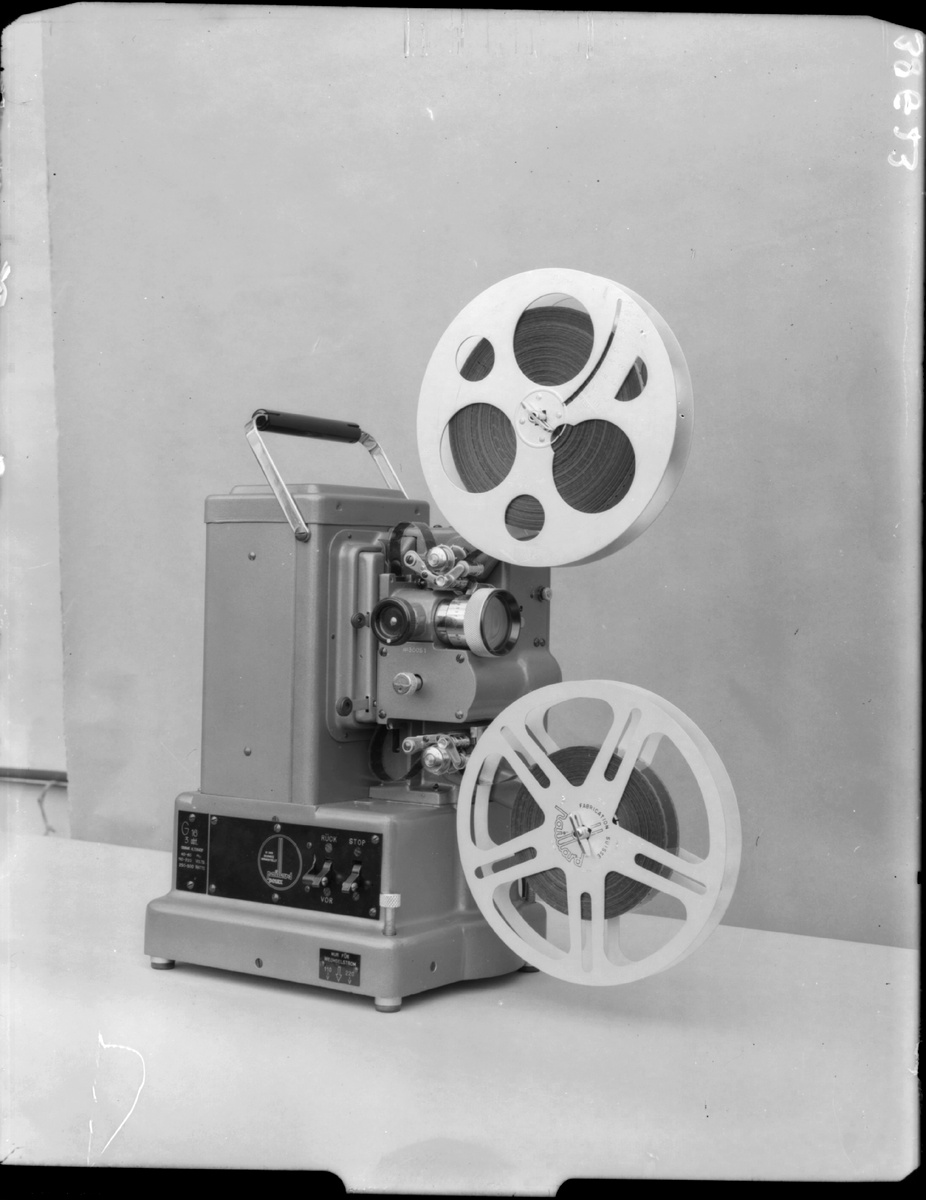
10 January 1937
A Paillard cine projector
Photographed on a glass plate in a studio, lit to show the mechanism. The Paillard name is legible on the lower reel. This is the earliest photograph of Paillard equipment this project has found that may be reused.
- Photograph
- Photographisches Institut der ETH Zürich
- Collection
- ETH Library Zurich, Image Archive
PI_38-G-0023 - Licence
- CC BY-SA 4.0
- Record
- View at source
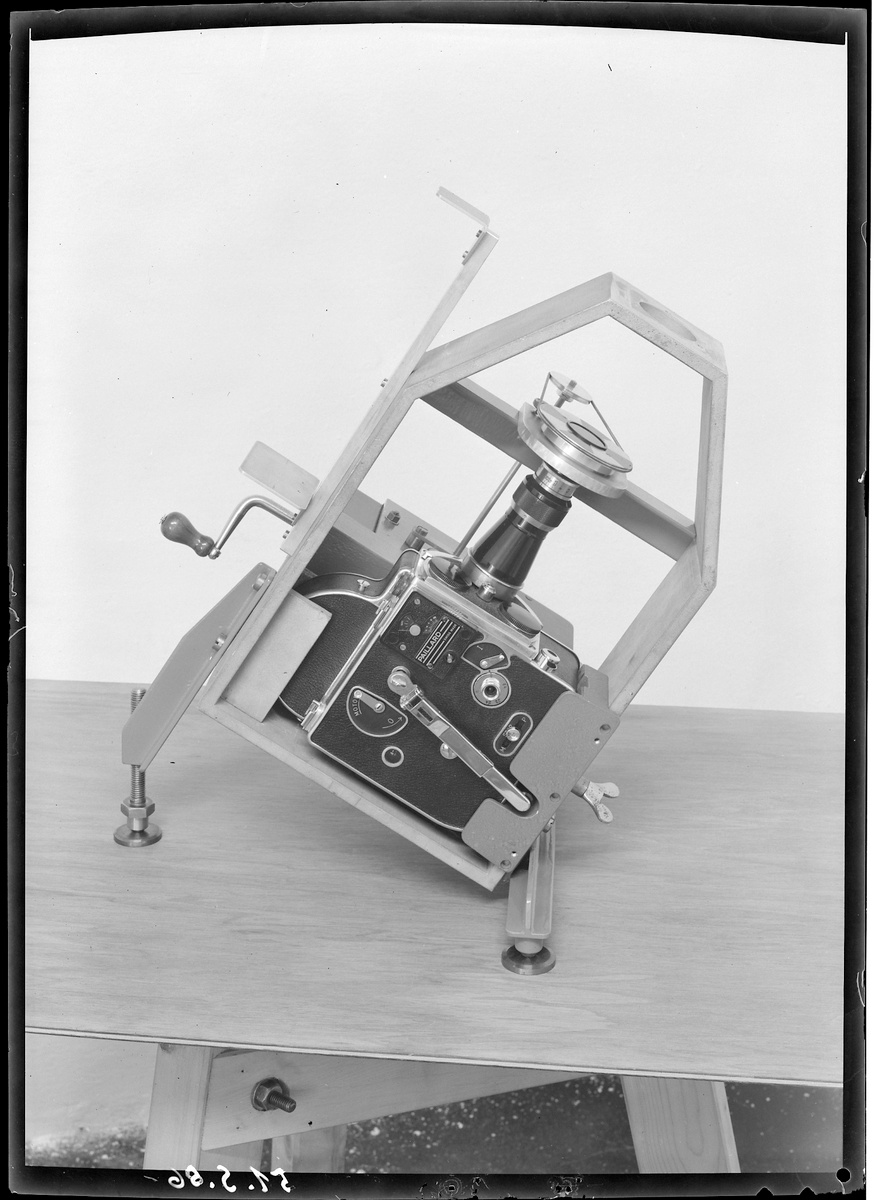
December 1951
A Paillard 16mm camera rigged for an eclipse
Built into a mount for the Swiss Federal Observatory to film the total solar eclipse, ordered by Max Waldmeier, ETH professor of astrophysics. A Bolex doing serious scientific work, photographed before it left for the expedition.
- Photograph
- Photographisches Institut der ETH Zürich
- Collection
- ETH Library Zurich, Image Archive
PI_51-S-0086 - Licence
- CC BY-SA 4.0
- Record
- View at source
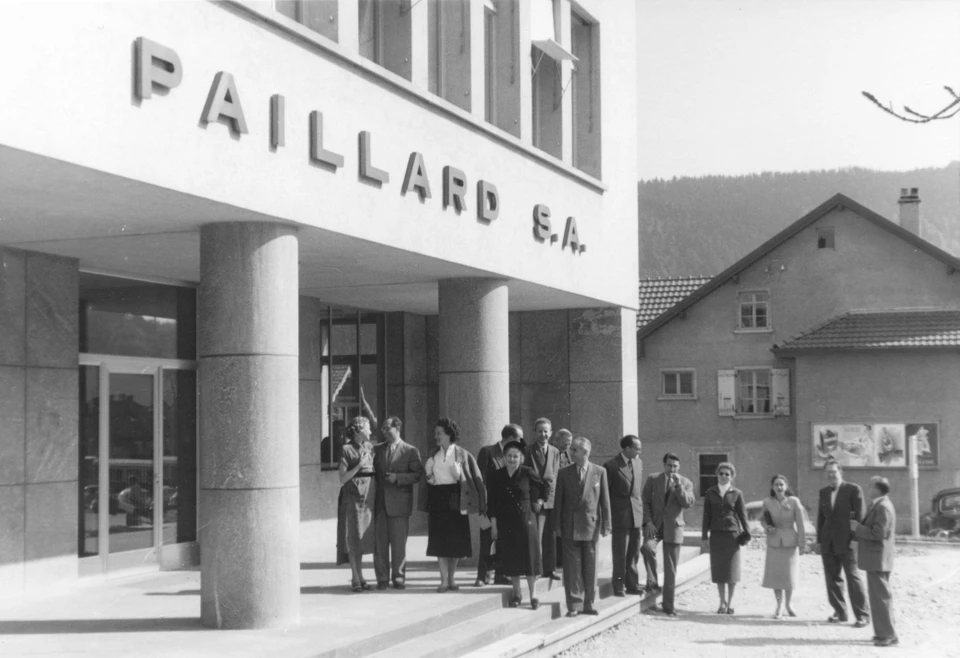
1950s
Outside the works at Sainte-Croix
Paillard periodically invited its dealers to tour the Sainte-Croix workshops so that the people selling the cameras had seen them made. This is one such party outside the entrance. It was published by Claudio Abächerli, whose father kept a photographic shop in Lugano and is in the middle of the group.
- Photograph
- Paillard SA
- Collection
- notreHistoire.ch, published by Claudio Abächerli
Une visite à l'usine Paillard à Sainte-Croix - Licence
- Public domain
- Record
- View at source
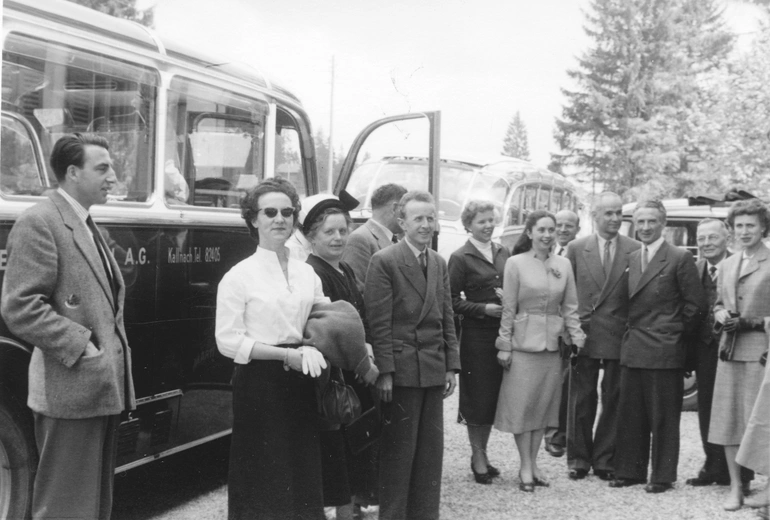
1950s
The dealers arrive
The same visit, as the coach brings the party up from Yverdon.
- Photograph
- Paillard SA
- Collection
- notreHistoire.ch, published by Claudio Abächerli
Une visite à l'usine Paillard à Sainte-Croix - Licence
- Public domain
- Record
- View at source
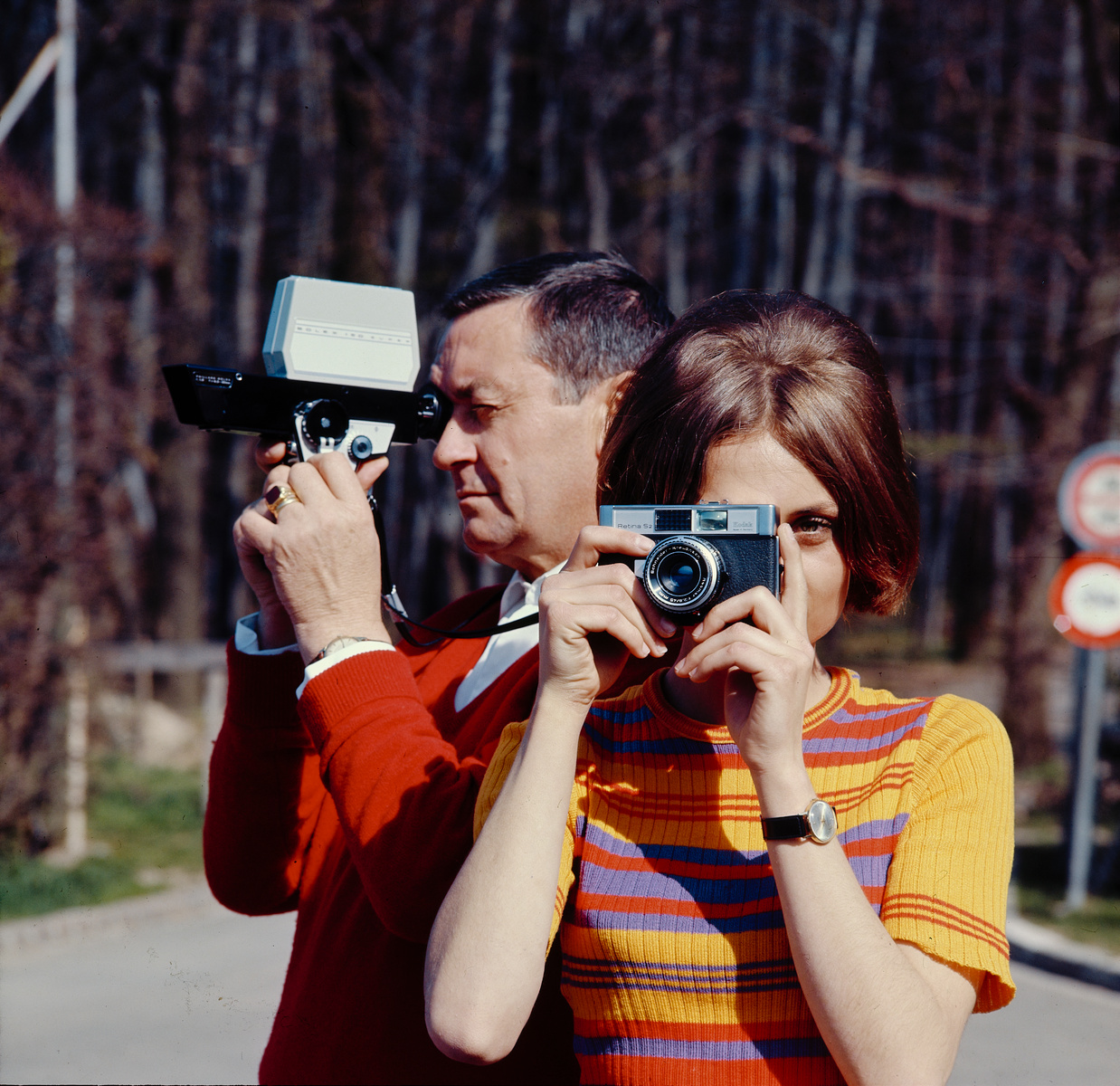
1967
The 150 Super, for a feature on amateur film-making
Shot by the press agency Comet for a piece titled Fototipps für Amateure. The 150 Super is on the left, a Kodak Retina S2 on the right. The chronology records the 150 Super's introduction in this same year.
- Photograph
- Jack Metzger (1918–1999)
- Collection
- ETH Library Zurich, Image Archive
Com_C16-049-005 - Licence
- CC BY-SA 4.0
- Record
- View at source
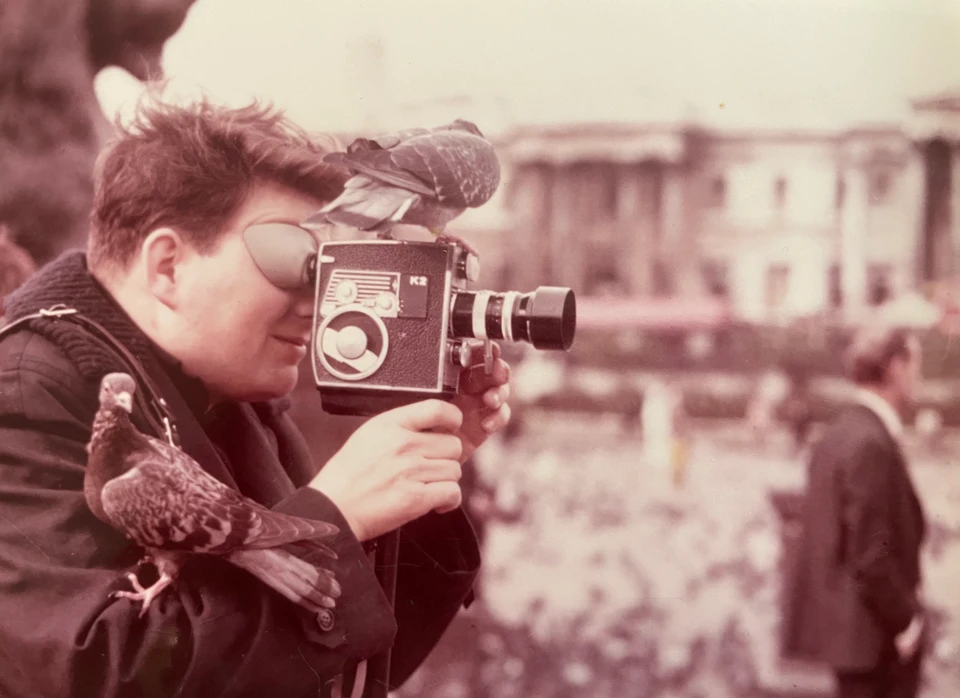
1960s
Filming in Trafalgar Square with a K2
Jean-Fred Friederich, who has filmed on Bolex cameras since 1963, photographed by his brother Eric while being overrun by pigeons. He rates the K2 the best of them for its Kern-Switar lens, and his 8mm film Trois jours à Londres came out of this trip. The record's period field reads 1930s, which the colour film and the camera both contradict; the 1960s is his own account.
- Photograph
- Eric Friederich
- Collection
- notreHistoire.ch, published by Jean-Fred Friederich
Caméra Bolex Paillard K2 à Trafalgar Square Londres - Licence
- CC BY-NC-ND 4.0Non-commercial use. Shown unaltered, as the licence requires.
- Record
- View at source
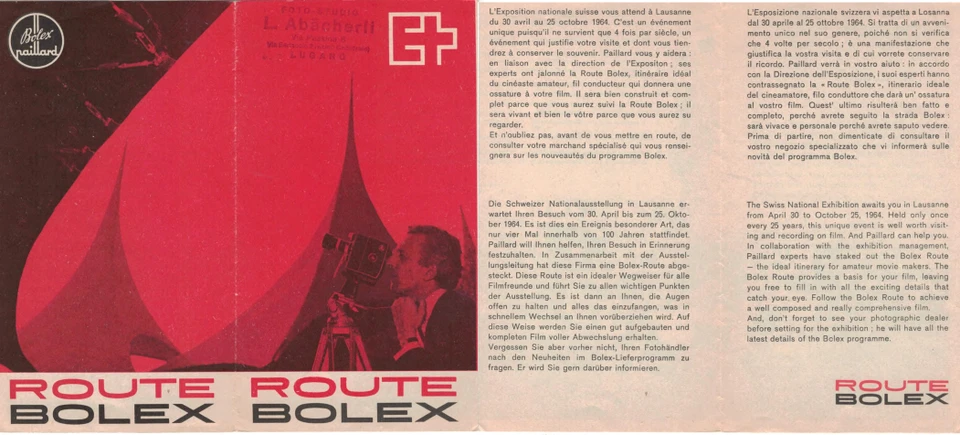
1964
The Route Bolex prospectus for Expo 64
For the Swiss National Exhibition at Lausanne, 30 April to 25 October 1964, Paillard marked out a route through the grounds for amateur film-makers, signposting the best places to shoot so that a visitor came home with a film that cut together. The leaflet went to photographic shops across Switzerland and is printed in French, German, Italian and English. This copy carries the stamp of Foto Studio L. Abächerli of Lugano, the shop whose dealers' visit to Sainte-Croix appears above.
- Photograph
- Photographer unrecorded
- Collection
- notreHistoire.ch, published by Claudio Abächerli
La Route Bolex à l’Expo 64 à Lausanne — Recto - Licence
- CC BY-NC-ND 4.0Non-commercial use. Shown unaltered, as the licence requires.
- Record
- View at source
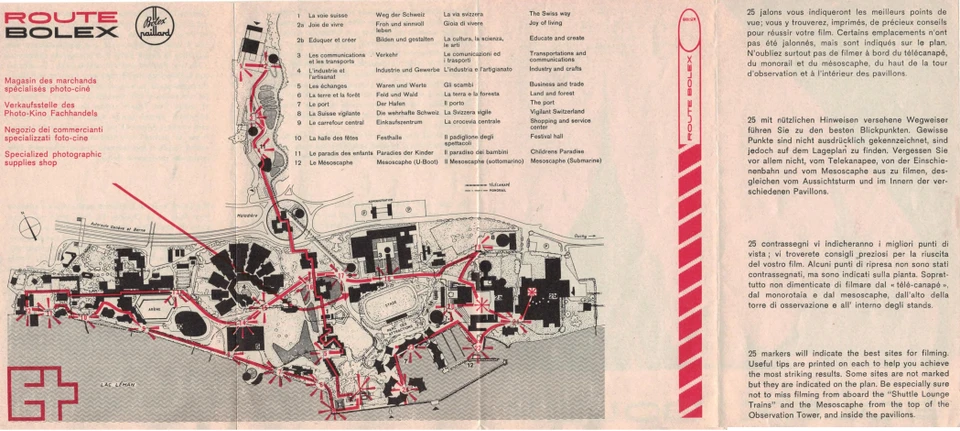
1964
The Route Bolex prospectus, reverse
The other side of the same leaflet.
- Photograph
- Photographer unrecorded
- Collection
- notreHistoire.ch, published by Claudio Abächerli
La Route Bolex à l’Expo 64 à Lausanne — Verso - Licence
- CC BY-NC-ND 4.0Non-commercial use. Shown unaltered, as the licence requires.
- Record
- View at source
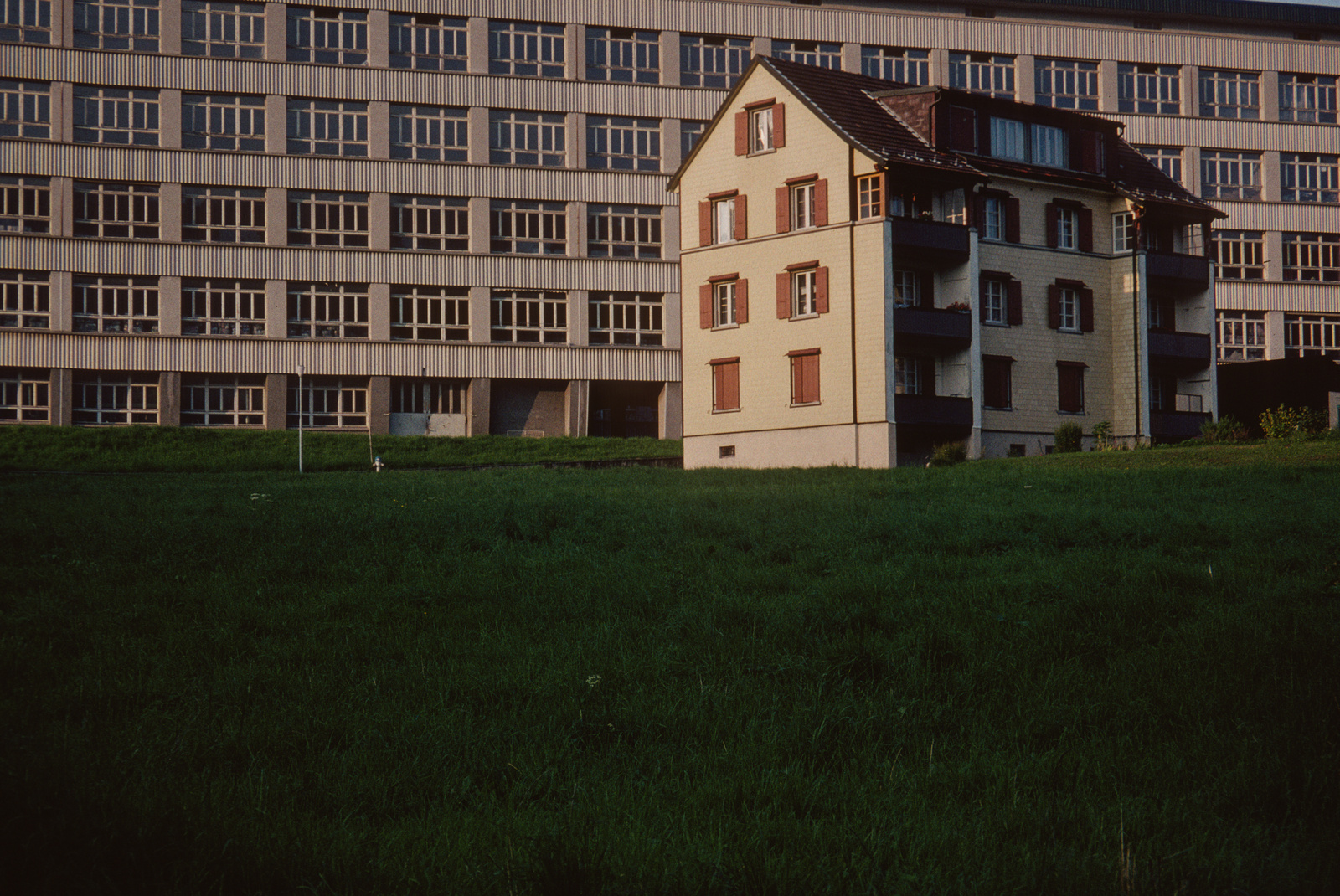
November 1996
The Paillard-Bolex-Hermes works, Sainte-Croix
Photographed by the industrial historian Hans-Peter Bärtschi, who spent his working life recording Swiss industry as it closed. The chronology this site recovered ends in 1970; the building outlasted it, and was offered for sale in 2002.
- Photograph
- Hans-Peter Bärtschi (1950–2022)
- Collection
- ETH Library Zurich, Image Archive
SIK_03-080632 - Licence
- CC BY-SA 4.0
- Record
- View at source
What is not here
There are photographs of Bolex cameras being assembled at Yverdon and of the Bolex repair workshop. They are held by the Musée d’Yverdon et région and published with all rights reserved, so they are not reproduced here. The same is true of the only surviving material found anywhere on Jacques Bogopolsky, who designed the camera the company was named for.
Bolex International’s own historical photographs are the best that exist of the early years. Its site states that they may not be reproduced without written permission, so none are used.
If you hold photographs of Paillard or Bolex and would be happy to see them preserved, the suggestions page reaches us directly.